Cloud Kitchen Marketing in India (2026): The Complete Playbook to Drive Orders

What Is Cloud Kitchen Marketing?
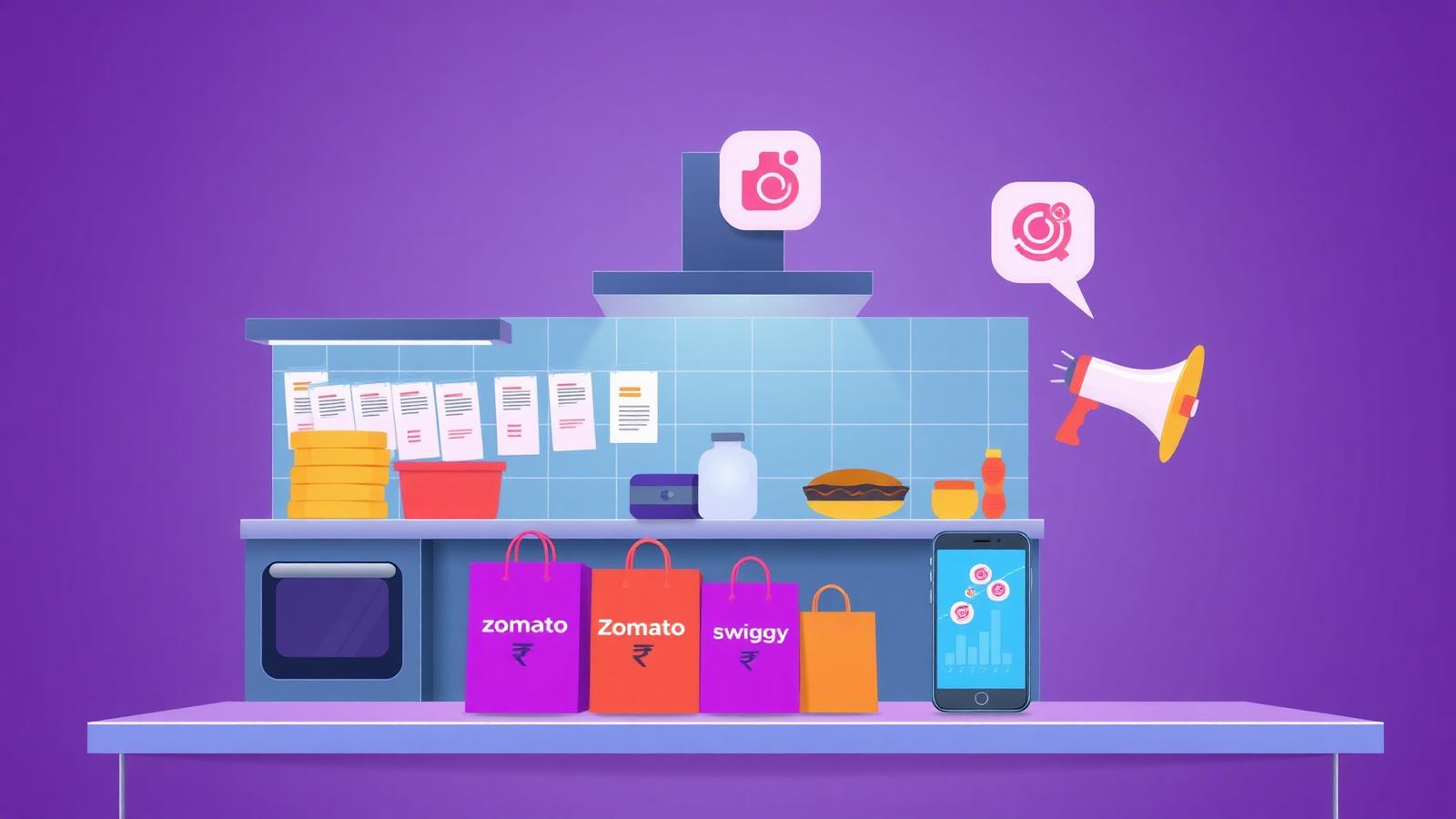
Cloud kitchen marketing is the discipline of driving delivery orders to a kitchen that has no dine-in footfall. Because a cloud kitchen (also called a dark kitchen or ghost kitchen) is invisible to walk-past traffic, 100% of demand has to be manufactured through Zomato, Swiggy, Instagram, WhatsApp and influencer channels. The economics are unforgiving: every order carries 20–28% commission, packaging, delivery discounting and rent — so marketing has to be measured on Cost Per Order (CPO), ROAS and contribution margin, not likes or reach. Digital Catapult has run cloud kitchen marketing across India since 2019 and treats it as its own P&L discipline, distinct from dine-in restaurant marketing.
Why Cloud Kitchens Need a Different Marketing Playbook
A dine-in restaurant can survive on walk-ins, corporate lunch tie-ups and hoardings. A cloud kitchen cannot. Every rupee of revenue is decided by four things: the Zomato listing, the Swiggy listing, the rating, and the ad account. Everything else (Instagram, WhatsApp, influencers) exists to feed those four surfaces. This is why 90% of cloud kitchens that fail in 2026 fail on aggregator execution — not on food quality. For the survival economics context, read our Cloud Kitchen Survival Guide 2026.
Pillar 1 — Zomato & Swiggy Listing Optimisation (the Non-Negotiable)
Every cloud kitchen marketing plan begins with the listing, because the listing decides both organic ranking and paid-ad relevance score. In 2026, a fully optimised Zomato and Swiggy listing for a cloud kitchen means: a keyword-rich brand name (e.g. "Biryani Baba — Hyderabadi Dum Biryani"), tight cuisine tags (never more than 3), 12–20 professionally shot food photos with a clear hero dish, a menu structured around 3–5 bestsellers pinned at the top, combos priced 15–25% below sum-of-parts, and a delivery radius capped at 2–3 km. Digital Catapult productises this through Zomato Listing Optimization and pairs it with Zomato Menu Engineering to lift Menu-to-Cart conversion above 25%.
Pillar 2 — Zomato Ads & Swiggy Ads (The Growth Lever)
For a cloud kitchen, aggregator ads are the fastest and most predictable growth lever — but only after the listing converts. The 2026 playbook: start with Swiggy Search Ads and Zomato Search Ads at ₹400–₹1,200/day per platform, per outlet. Add Collection Ads once Search is profitable, and add Ads Boost / Home Ads only for launches or offers. Never enable smart bidding on day one — the algorithm needs 30+ weekly conversions to bid intelligently. For the full ad playbooks, see our Zomato Ads Complete Guide (2026) and Swiggy Ads Complete Guide (2026). Model ROI before you spend using the free Ads ROI Calculator.
Pillar 3 — Ratings & Reviews (The Ranking Multiplier)
Rating is the single strongest signal both Zomato and Swiggy use to rank a cloud kitchen. In 2026, the thresholds are non-negotiable: ≥ 4.2 rating, ≥ 40 net new 4★+ reviews in the last 30 days, and complaint resolution within 4 hours. A cloud kitchen at 3.9 rating pays 25–40% higher effective CPC on ads than the same brand at 4.3 — for the same slot. The playbook: send an automated WhatsApp review request 20–40 minutes after every delivery, personally reply to every 1-3★ review within 4 hours, and treat packaging integrity as a marketing spend (leaking packaging is the #1 cause of rating drops). For the deeper ranking playbook, read Zomato Ranking Signals: Velocity, Ratings & M2C.
Pillar 4 — Instagram & Social Media for Cloud Kitchens
Instagram does not drive first-time delivery orders for a cloud kitchen — Zomato and Swiggy do. What Instagram does is build the repeat-order flywheel: followers order 2.3× more often than one-time buyers. The 2026 cadence: 12–16 Reels per month, weighted 60% dish hero Reels, 25% behind-the-kitchen and story-led Reels, 15% offer/UGC re-posts. Every caption and story ends with "Order on Zomato/Swiggy" and a link sticker. YouTube Shorts and Google Business Profile posts extend reach at zero incremental effort. Do not spend on Instagram until the aggregator listing is already converting — social amplifies existing demand; it does not create it.
Pillar 5 — WhatsApp Retention (The Cheapest ROAS in the Stack)
WhatsApp is the highest-ROI channel a cloud kitchen has because it costs almost nothing per message and it reaches customers who already loved the food. Build the list from every completed order (Zomato/Swiggy provide the phone number to the restaurant). Send at most 3–4 broadcasts per month — a new-dish launch, a weekend combo, a festival offer, a birthday coupon. Cloud kitchens that run WhatsApp properly typically add 12–20% incremental orders/month at a CPO under ₹8. Do not spam — WhatsApp Business will throttle a number that gets blocked repeatedly, and that is a hard-to-recover asset.
Pillar 6 — Influencer Marketing for Cloud Kitchens
Cloud kitchens have no physical footfall, so word-of-mouth has to be manufactured. Micro-influencer marketing (creators with 10k–100k followers, strictly inside your delivery catchment) is the highest-trust discovery channel available. A single well-placed Reel from a trusted local food creator typically lifts Zomato/Swiggy searches for the brand by 20–40% for 5–7 days. The playbook: 2–4 micro activations per month, structured as barter tastings for volume + content library, and paid Reels for launches and offer pushes. Digital Catapult operates a vetted micro-creator network across Delhi NCR, Mumbai, Bangalore and Hyderabad specifically for cloud kitchens.
Cloud Kitchen Marketing Budget: How to Split ₹50,000/Month
- Zomato Ads: ₹15,000/month (Search + Collection, per cuisine campaigns).
- Swiggy Ads: ₹15,000/month (Search-heavy, with a small Collection allocation).
- Instagram content production: ₹8,000/month (12–16 Reels, dish-hero shooting).
- Micro-influencer activations: ₹8,000/month (2–3 creators, mostly barter + one paid).
- Photography refresh: ₹4,000/month (blended — full reshoot every 60 days).
Sanity-check the split against your per-order contribution margin using the Food Cost Calculator. If ad-driven CPO exceeds contribution margin, cut ad budget first, not content or influencer.
Multi-Brand Cloud Kitchen Marketing (3–6 Virtual Brands, One Kitchen)
A multi-brand cloud kitchen runs 3–6 virtual brands out of one kitchen — biryani, pizza, Chinese, healthy bowls, desserts. Each brand needs its own Zomato listing, Swiggy listing, food photos, rating cycle, ad account and content calendar. Marketing complexity scales linearly with brand count, so most owners underestimate the workload. The rule: only launch a second virtual brand when the first crosses 400–500 orders/month at a stable 4.2+ rating. Launching three brands together almost always dilutes all three below the 4.2 rating floor and starves each ad account of learning signal.
Launch Playbook: First 100 Orders on a New Cloud Kitchen
- Go live on Zomato and Swiggy the same day — never one before the other.
- Shoot 15–20 food photos before day one: hero dish + bestsellers + combos + packaging shot.
- Soft-launch offer (30–40% off for first-time users) for 14 days to build order velocity.
- Automated WhatsApp review request within 30 minutes of every delivery.
- Start Swiggy Search Ads + Zomato Search Ads on day 8 at ₹500/day per platform.
- Publish 3–5 Reels/week from the kitchen — hero dish, packing shots, rider handover.
- 1 micro-influencer activation in week 2, a second in week 3.
- By day 30: 100+ orders, rating stabilised at 4.2+, first ad-account learning phase complete.
Cloud Kitchen Marketing KPIs (What to Track Weekly)
- CPO (Cost Per Order): per platform, per cuisine. Must sit below per-order contribution margin.
- Blended ROAS: ad-driven revenue ÷ ad spend, across Zomato + Swiggy combined.
- Rating & net-new 4★+ reviews (30 days): ≥ 4.2 rating, ≥ 40 reviews.
- Menu-to-Cart conversion (M2C): ≥ 25% off-peak, ≥ 32% peak.
- KPT (Kitchen Preparation Time): ≤ 12 minutes. Anything higher demotes the listing.
- Repeat-order rate on ad-acquired customers: ≥ 22% within 30 days.
- WhatsApp broadcast conversion: ≥ 4–6% of receivers ordering within 48 hours.
Common Cloud Kitchen Marketing Mistakes
- Spending on Instagram before the Zomato/Swiggy listing converts. Amplifying a broken funnel just burns money faster.
- Launching 3+ virtual brands in month one — none of them get enough learning signal to stabilise.
- Discounting deeper than 40% to fake velocity. Zomato and Swiggy discount-tag such listings and repeat-order rate collapses.
- Not resetting food photography every 60 days — CTR fatigues on both apps.
- Ignoring KPT. A cloud kitchen with 18-minute KPT will never rank in the top 3 slots regardless of ad spend.
- Chasing followers on Instagram instead of "Order Now" click-through.
- Letting an agency mark up Zomato / Swiggy / Meta media spend — always insist on media at cost.
Delhi NCR, Mumbai, Bangalore, Tier 2 Cities: Where Marketing Playbooks Diverge
Cloud kitchen marketing playbooks are hyperlocal in 2026. Delhi NCR, Mumbai and Bangalore have the deepest delivery demand and the highest average order values, but effective Zomato/Swiggy CPCs run 30–50% higher than in Tier 2/3 cities. Tier 2 cities (Jaipur, Chandigarh, Indore, Lucknow, Coimbatore) have cheaper media and lower rent, so the same ₹40,000/month often delivers 30–50% more orders. Digital Catapult tailors the mix accordingly — for the deeper playbook see Zomato Tier 2 / Tier 3 City Marketing Playbook.
Should You Hire a Cloud Kitchen Marketing Agency?
DIY cloud kitchen marketing works when monthly online revenue is under ₹3L, you run a single brand, and CPO consistently sits below per-order margin. Beyond that, a specialist cloud kitchen marketing agency pays for itself in month one — dedicated Zomato/Swiggy dashboard management, per-brand ad structuring, weekly CPO/ROAS reporting, and an owned influencer network usually cut blended CPO by 20–35%. Digital Catapult delivers this through its full-service Restaurant Marketing Agency retainer, or on a channel-specific basis via Zomato Marketing Agency and Swiggy Marketing Agency. For the sister playbook covering both platforms together, see Zomato & Swiggy Marketing Agency 2026.
Frequently Asked Questions
How do I market a cloud kitchen in India in 2026?
Cloud kitchen marketing in India in 2026 is 80% aggregator work and 20% brand work. The 80%: win Zomato and Swiggy through a fully optimised listing (12+ food photos, hero dish, tight cuisine tags), keep rating above 4.2, run Swiggy Search Ads and Zomato Ads with a per-cuisine CPO target, and hold KPT under 12 minutes so both algorithms keep boosting you. The 20%: build a repeat-order engine on Instagram Reels and WhatsApp, and layer 2–4 micro-influencer activations per month in your delivery catchment. Everything else (ATL, print, hoardings) is a waste of a cloud kitchen budget.
How much does cloud kitchen marketing cost per month?
In India in 2026 a single-brand cloud kitchen typically spends ₹25,000–₹80,000/month on marketing: ₹15,000–₹45,000 on Zomato + Swiggy Ads combined, ₹5,000–₹15,000 on Instagram content, and ₹5,000–₹20,000 on influencer activations. Multi-brand cloud kitchens (3–6 virtual brands from one kitchen) scale to ₹1L–₹3L/month total, because each virtual brand needs its own ad account, creatives and rating cycle. Media should always be billed at cost by any cloud kitchen marketing agency you hire — never marked up.
How do cloud kitchens get their first 100 orders on Zomato and Swiggy?
Launch playbook for a new cloud kitchen: (1) go live on Zomato and Swiggy the same day; (2) shoot 15–20 food photos before day one — hero dish + bestsellers + combos; (3) run a soft-launch offer (30–40% off for first-time users) for 14 days to build order velocity; (4) request reviews from every order via WhatsApp within 30 minutes of delivery; (5) start Swiggy Search Ads and Zomato Ads on day 8 with ₹500/day per platform; (6) push 3–5 Reels/week from the kitchen. Most well-run cloud kitchens hit 100 orders in the first 21–30 days with this stack.
What is a good ROAS for a cloud kitchen on Zomato and Swiggy?
For a cloud kitchen in India in 2026, healthy blended ROAS is 4.5×–6×. QSR / biryani / North Indian cloud kitchens usually land 4.5–5.5×; pizza and Chinese 5–6×; premium and dessert cloud kitchens 6–8×. The number that decides profitability is Cost Per Order (CPO), not ROAS — a cloud kitchen with ₹85 contribution margin per order must keep CPO under ₹55 to make money on ad-acquired orders.
Do cloud kitchens need Instagram and social media?
Yes, but not for the reason most owners think. Instagram doesn't drive delivery orders directly — Zomato and Swiggy do. But Instagram Reels and Stories build the repeat-order flywheel: users who follow the brand order 2.3× more often than one-time buyers. For a cloud kitchen, the right cadence is 12–16 Reels/month focused on the hero dish, behind-the-kitchen visuals and combo offers, with a clear 'Order on Zomato/Swiggy' link in every caption and story.
How important is influencer marketing for a cloud kitchen?
Very — because a cloud kitchen has no physical footfall to build word-of-mouth. In India in 2026 the winning play is 2–4 micro (10k–100k followers) food creator activations per month, strictly inside your delivery catchment. A single Reel from a trusted local food creator often lifts Zomato/Swiggy searches for the brand by 20–40% for 5–7 days. Digital Catapult runs a curated micro-influencer network across NCR, Mumbai and Bangalore specifically for cloud kitchens.
How do I reduce Zomato and Swiggy CPO for my cloud kitchen?
Five levers, in order of impact: (1) lift rating to 4.2+ (ad relevance score jumps, CPCs drop 20–30%); (2) shoot new food photos every 45–60 days (fights CTR fatigue); (3) tighten delivery radius to 2–3 km (higher M2C, lower CPO); (4) daypart ad bids up 20–30% in peak windows and down 30–50% in dead hours; (5) split campaigns per cuisine — never one giant campaign. Cloud kitchens that do all five typically cut CPO by 25–40% in 60 days.
Should a cloud kitchen run one brand or multiple virtual brands?
Depends on kitchen utilisation. A single-brand cloud kitchen is easier to market because the rating, reviews and content compound. Multi-brand cloud kitchens (3–6 virtual brands sharing one kitchen) unlock 2–3× revenue from the same fixed cost — but each brand needs its own listing, photos, ratings cycle, ad budget and content calendar. Only launch a second virtual brand once the first crosses 400–500 orders/month and rating is stable above 4.2.
Which cities are best for cloud kitchens in India in 2026?
Delhi NCR (Gurgaon, Noida, Faridabad, Ghaziabad), Bangalore, Hyderabad, Mumbai and Pune have the deepest delivery demand and highest average order value — but also the highest Zomato/Swiggy CPCs and competitive intensity. Tier 2 cities (Jaipur, Chandigarh, Indore, Lucknow, Coimbatore) have 30–50% lower CPCs and 20–30% lower rent, so unit economics are often better. For a marketing playbook by city tier, see our Tier 2/Tier 3 city marketing guide.
Should I hire a cloud kitchen marketing agency?
Hire an agency when monthly online revenue crosses ₹3L, when you run 2+ virtual brands, or when CPO consistently exceeds per-order margin. A specialist cloud kitchen marketing agency like Digital Catapult manages Zomato & Swiggy dashboards, ads, ratings and influencer activations as a full-time discipline — usually cutting blended CPO by 20–35% and paying for itself in month one.
Stop guessing why your competitors are #1.
Get a Free Audit and uncover exactly where you're losing money on platform fees, ads, and menu mix.
Get Free Audit